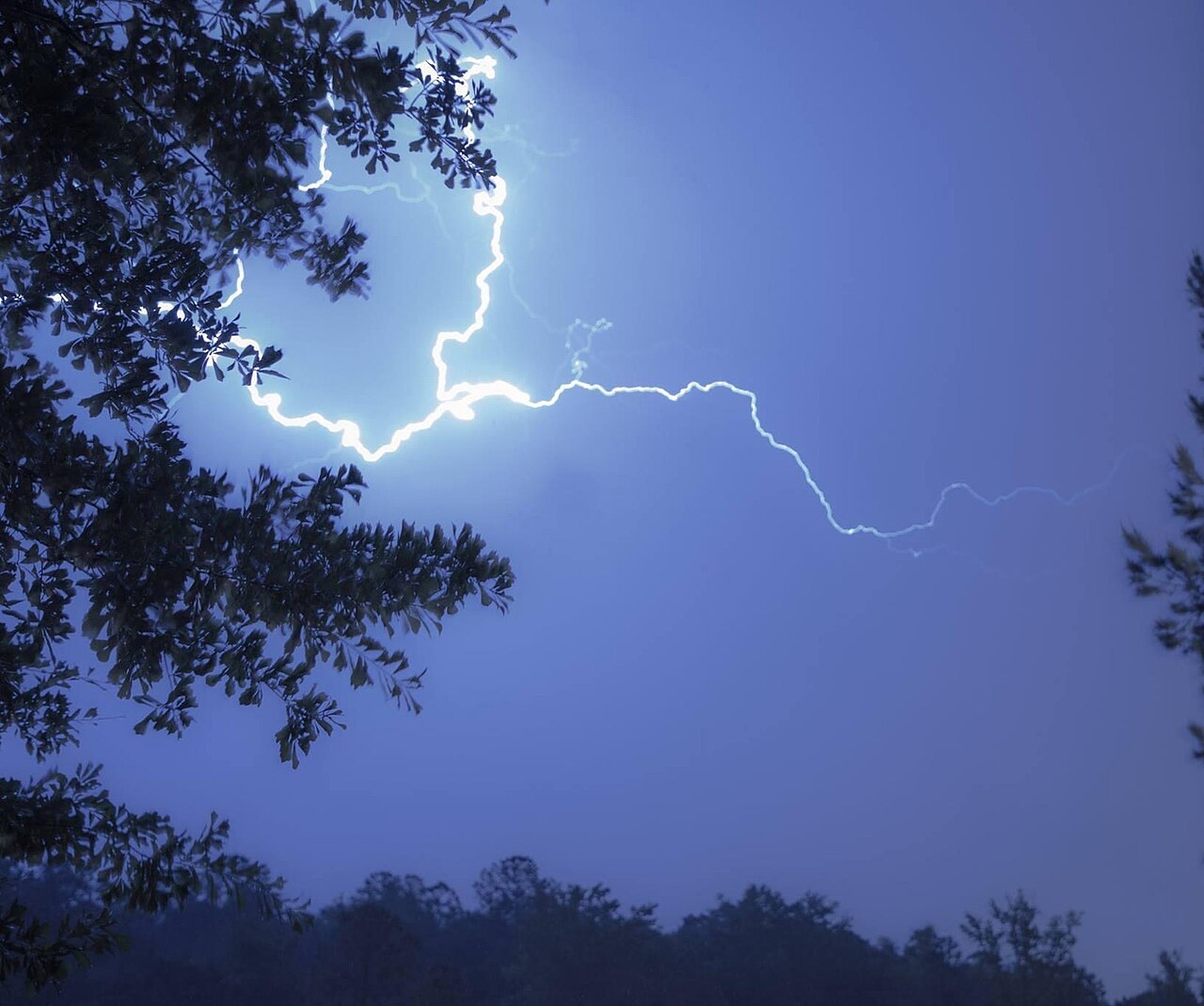
Why a lightning bolt looks jagged
The charged regions inside a thunderstorm create strong electric fields. When the electric field becomes intense enough, a channel of air starts becoming conductive. But the discharge does not simply choose a single straight line between two endpoints. Instead, the channel develops through many local steps, responding to electrical conditions near its growing tip. The US National Weather Service calls an important downward-developing channel a stepped leader. The multiple small changes in direction give the eventual lightning flash its familiar jagged shape.
What a stepped leader actually does
According to the National Weather Service, a typical negative cloud-to-ground leader develops in successive segments, sometimes on the order of tens of meters each. The tip responds mainly to nearby electric charge and to the air directly ahead, rather than knowing the complete future path to the ground. This produces a winding route that can turn sideways and branch. High-speed cameras reveal many of the faint leader steps, but the whole process is too fast for the human eye to distinguish. Exact step lengths and speeds vary between flashes.
Why lightning branches in several directions
As a leader advances, more than one nearby path may become ionized. Several branches can grow outward while the electrical field changes. Some side channels fade without reaching a connection, while another eventually links to an upward-growing channel from the ground or an object. Branches are thus evidence of competing conductive pathways, not a lightning bolt deliberately searching for trees. A large visible fork does not necessarily mean several places were struck. The precise number of branches depends on the electrical environment.
The brightest flash is a return stroke
When a descending leader connects with an upward streamer, a conducting channel is established. A powerful return stroke propagates upward through this channel and produces the bright light most people recognize as a lightning bolt. The National Weather Service explains that the bright flash can move along the already jagged path in a fraction of a second. More than one return stroke may follow within a single flash, making lightning appear to flicker. The initial faint leader and the later return stroke happen so quickly that we usually see them as one event.
Does lightning always take the shortest route?
No. The phrase 'lightning always takes the path of least resistance' is a misleading oversimplification when used to claim the flash knows the shortest geometric route in advance. Electric fields and local ionization continually influence how the leader grows. A tall object can increase the likelihood of attachment, but lightning can also strike open ground or nearby shorter objects. You cannot predict a safe location by studying the shape of a distant bolt. A branch pointing sideways is still part of a potentially dangerous electrical event.
Stay safe when a thunderstorm approaches
If you can hear thunder, lightning may be close enough to pose a risk. Move into a substantial enclosed building or a fully enclosed metal-topped vehicle with windows closed, according to local lightning-safety guidance. Do not shelter under isolated trees, stand in open fields or remain near water. Wait for the storm to pass before resuming outdoor activities, following official local advice. Related MURDILIMAX explanations include /guides/thunderstorm-hiking-safety/, /guides/how-fog-forms-types-and-safety/ and /guides/why-sky-blue-sunset-red/.
A general educational overview, not a substitute for professional guidance. Check current local rules and trusted primary sources before making consequential decisions.
Share this article