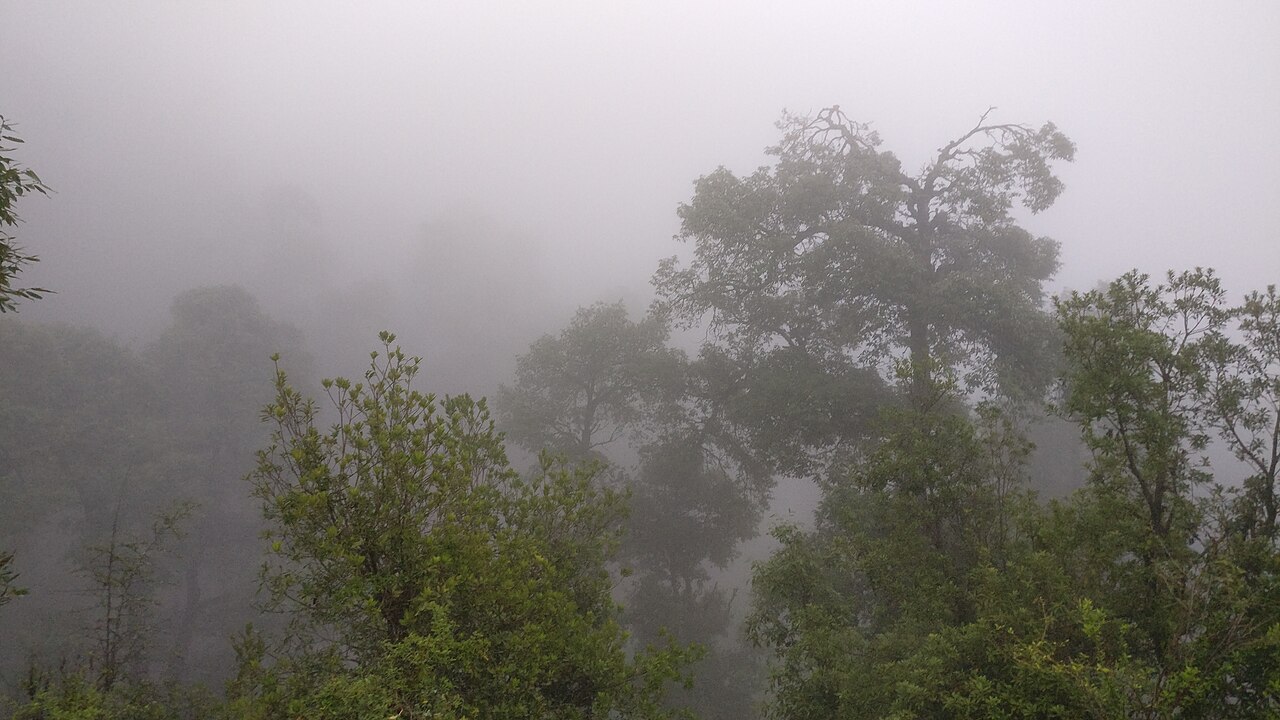
Fog is a cloud at ground level
Fog consists of tiny water droplets or, in very cold conditions, ice crystals suspended close to Earth's surface. It forms when air becomes sufficiently saturated that water vapor condenses. Cooling moist air toward its dew point is one common path; mixing air masses and adding moisture can also contribute. You do not need visible rain to have fog. A layer of fog can sharply reduce visibility even if the sky looks clear from a nearby hill or tall building.
Why early mornings are often foggy
On calm, clear nights, the ground loses heat and cools the air just above it. If that air contains enough moisture, cooling can bring it to saturation and fog can form. Meteorologists call this radiation fog. It often appears in autumn or winter, especially after moist weather. Light winds can help mix a shallow layer, but stronger winds may disperse it. Sunshine can warm the surface and thin the fog after sunrise, though thick fog sometimes lasts much longer.
Why valleys, rivers and lakes matter
Cooler, denser air can drain into valleys during the night and settle there, making local fog patches more likely. Nearby rivers and lakes can supply moisture to the air. Fog is therefore not distributed evenly across a city or countryside: one stretch of road may be clear while a lower, sheltered area is almost opaque. If a forecast says 'patchy fog,' expect rapid changes rather than assuming the same visibility everywhere. The effect is particularly important to drivers on rural roads.
Radiation fog versus advection fog
Radiation fog develops when air near the ground cools in place. Advection fog forms when moist air moves over a colder surface and cools, often near coasts or large bodies of water. There are also freezing fog, steam fog and other specialized types. Each has a different weather setup; the common result is poor visibility from suspended droplets or ice. Fog does not always vanish as soon as the Sun appears, especially when a persistent cool layer remains trapped near the surface.
Mist, clouds and air pollution
Mist is commonly used when the drop in visibility is less severe than in fog, although definitions vary by meteorological agency. Haze and smoke can also obscure a view but do not form in exactly the same way as condensation fog. A white-looking cloud near the ground does not reveal whether airborne pollution is present. Check local air-quality and weather observations when either is important. Do not treat poor visibility as a direct measure of air pollution.
How to stay safe in fog
Slow down when driving, increase following distance and use appropriate low-beam headlights in accordance with local road rules. High beams may reflect back from fog and make it harder to see. If conditions become unsafe, stop in a designated safe area rather than on the travel lane. Cyclists and pedestrians should use conspicuous lights or reflective gear. For related atmospheric questions, see /guides/cloud-types-field-guide/ and /guides/double-rainbow-explained/.
A general educational overview, not a substitute for professional guidance. Check current local rules and trusted primary sources before making consequential decisions.
Share this article