The short answer: solid ice is less dense
A piece of ice floats in liquid water because the average density of ordinary ice is lower than that of liquid water. Density describes mass divided by volume: the same mass can occupy more space and therefore have lower density. The US Geological Survey notes that water's density decreases by roughly nine percent on freezing under ordinary conditions. An ice cube rises until the water it displaces has the same weight as the cube. That is why only part of an iceberg sticks above the surface.
Hydrogen bonds create an open crystal structure
Water molecules attract one another through hydrogen bonding. In liquid water, the molecules continually move and their network rearranges. As water freezes into ordinary hexagonal ice, these interactions favor a more ordered and open lattice that holds molecules farther apart on average. The same number of molecules therefore occupies a larger volume. You do not need to assume that ice contains trapped air for it to float: even clear, bubble-free freshwater ice is less dense than liquid freshwater at comparable pressure.
Why many other solids sink in their liquids
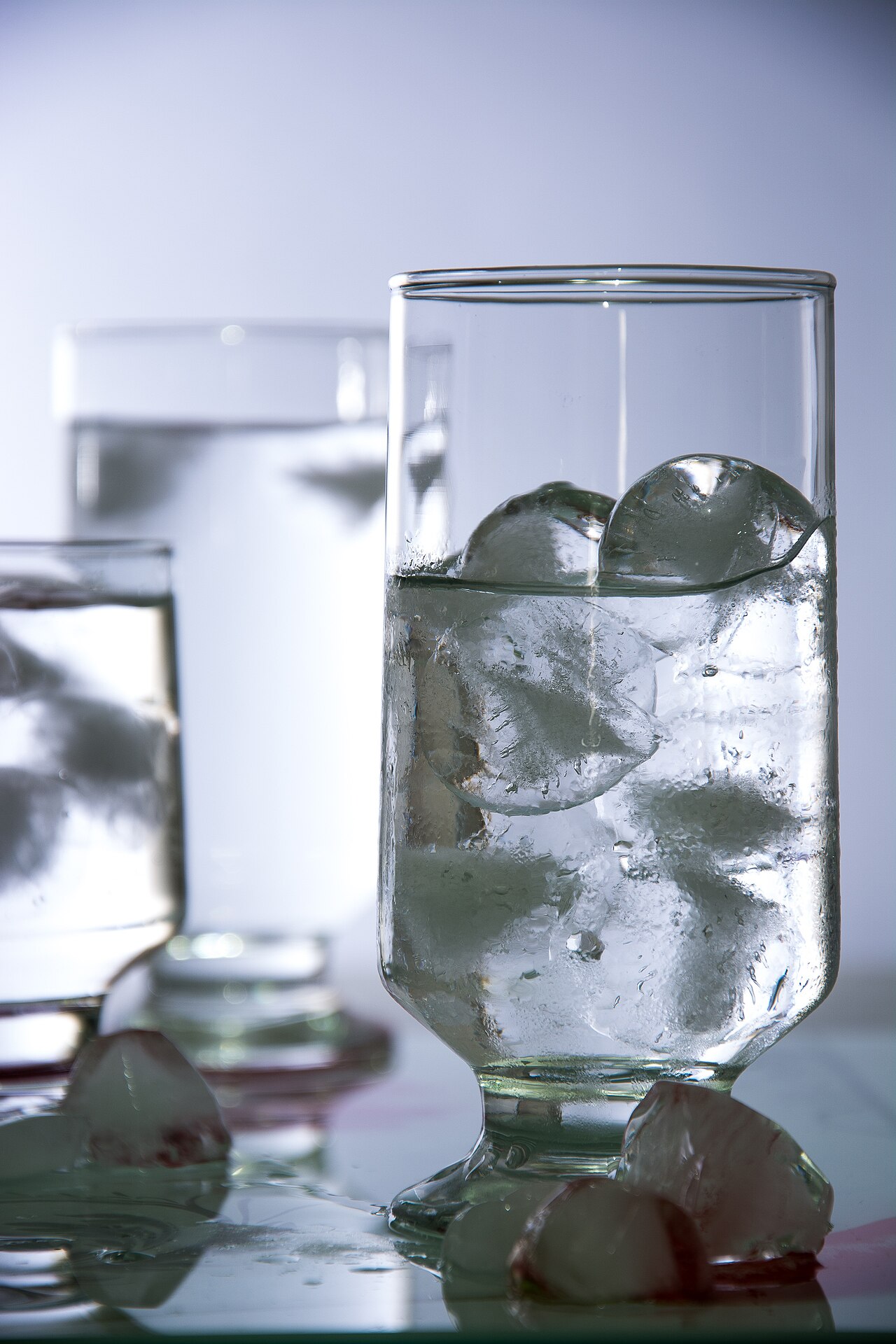
For many substances, cooling into a solid lets particles pack into a denser arrangement than in the melt. The solid then sinks in its own liquid. Water behaves differently across the familiar temperature range because its molecular network becomes relatively open when freezing. This exception can be observed safely by putting a clean ice cube in a glass of water. The cube floats with most of its volume underwater; the exact visible fraction varies with impurities, bubbles and the difference between fresh and salty water.
What is special about water near 4°C?
Pure liquid freshwater becomes densest near 4°C at ordinary pressure, rather than right at freezing. Water cooled below that point is less dense and tends to remain near the surface when lake conditions allow stable layering. Ice forms at the surface, and the layer below can remain liquid. Wind, currents, lake depth and dissolved salts can change actual behavior, so real lakes are more complex than a laboratory glass. USGS highlights that this property has profound ecological consequences for aquatic organisms surviving through cold seasons.
How icebergs float and why sea ice is different
An iceberg floats because seawater is dense enough to support it, and a large fraction of the iceberg stays underwater. Ocean salinity affects buoyancy, so the proportion above the surface is not exactly the same as for ice in a glass of freshwater. Sea ice also forms from seawater and can contain brine pockets and air. Melting floating sea ice is different from glacier ice moving off land into the ocean, a distinction that matters for sea-level discussions. Do not use one classroom demonstration to oversimplify global ice behavior.
Try a quick observation and related reading
Fill a transparent glass with water and gently place a small ice cube in it, then mark the water level and watch the cube melt. For ordinary floating freshwater ice, melting roughly replaces the water already displaced, so the level changes little. Avoid using an expensive or delicate container that could crack from rapid temperature changes. This is a simple way to connect buoyancy, density and phase changes. Explore related MURDILIMAX topics at /guides/why-moon-orange-near-horizon/, /guides/how-fog-forms-types-and-safety/ and /topics/nature/.
A general educational overview, not a substitute for professional guidance. Check current local rules and trusted primary sources before making consequential decisions.
Share this article