Start with sunlight and water
White sunlight contains different wavelengths. Light bends as it enters a water drop, partly reflects inside it and bends again as it leaves. Different wavelengths bend by different amounts, creating the colours we see. For an ordinary solar rainbow, the Sun is behind the observer and illuminated droplets are ahead. Rain alone is not enough without suitable lighting.
Where the second rainbow comes from
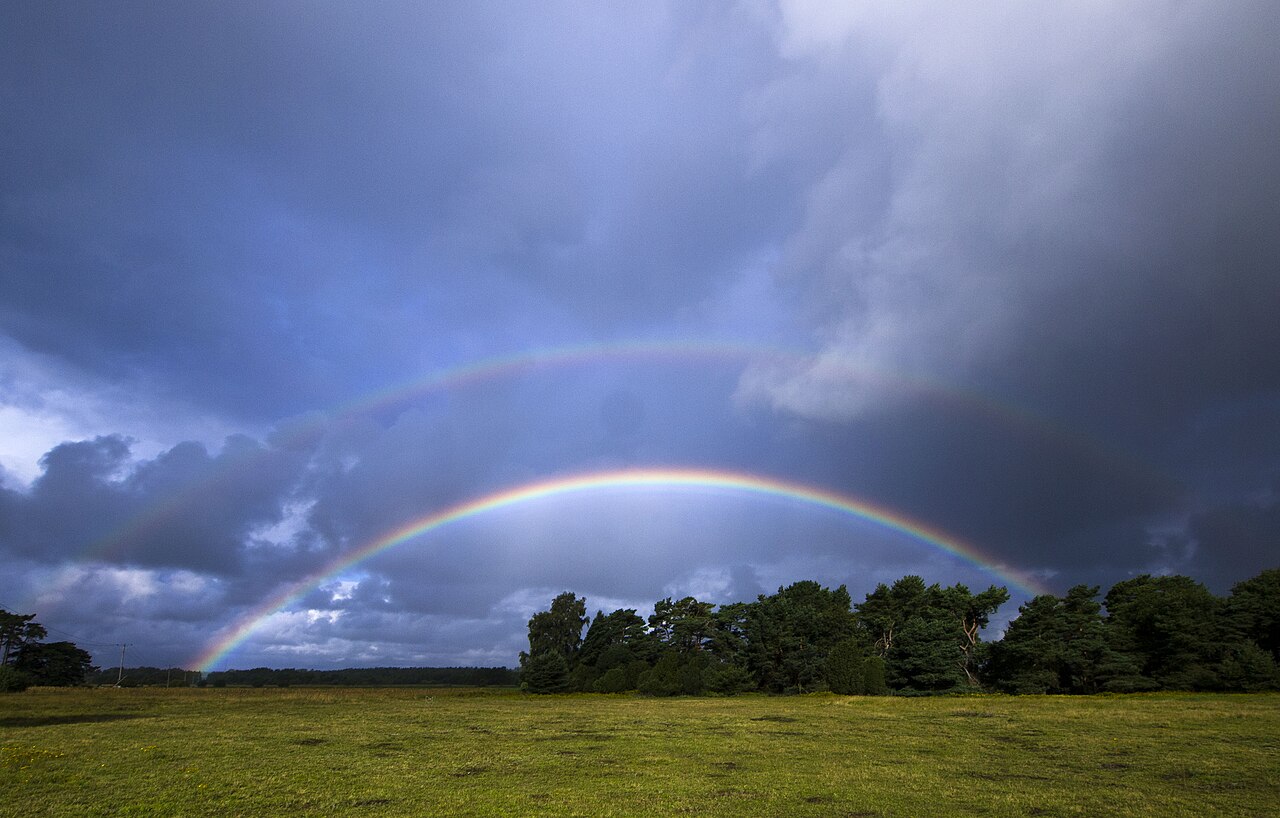
Light forming the primary rainbow undergoes one internal reflection in a drop; light forming the secondary undergoes two. The extra reflection changes the angle at which it emerges, placing the second bow outside the first. It is usually fainter because light is lost along the way. A double rainbow does not require two Suns or one bow reflected from a cloud.
Why the colours reverse
Red is on the outside of the primary bow and violet on the inside. In the secondary bow this order reverses, putting red towards the gap between the two rainbows. That is a useful detail to look for in a photograph. The colours are not sharply separated paint stripes: the spectrum is continuous, and the traditional seven colours are names for portions of it.
The dark gap between the bows
The area between the primary and secondary bows is called Alexander’s band. Because of the geometry of light travelling through droplets, less light associated with these rainbows reaches the observer from this region. It looks darker beside the brighter neighbouring areas. It is not a separate cloud or a shadow cast by the second bow, although real clouds also affect the background.
Why you cannot reach its end
A rainbow depends on the relative positions of the Sun, droplets and observer rather than being attached to a particular house or tree. When you move, different drops send light towards you. The full geometry of a rainbow is a circle, but from the ground part is normally hidden by the horizon. An elevated viewpoint can sometimes reveal the entire circle.
Try a simple observation
From a safe position, compare the brightness of the two bows, their colour order and the gap between them. Note the time and your viewing direction to relate the arc’s height to the Sun’s position. Morning and late afternoon often offer useful conditions because the Sun is low. Stay off roads when taking photographs; if thunder is audible, continue observing from safe shelter.
A general educational overview, not a substitute for professional guidance. Check current local rules and trusted primary sources before making consequential decisions.
Share this article