The short answer: sunlight scatters in the atmosphere
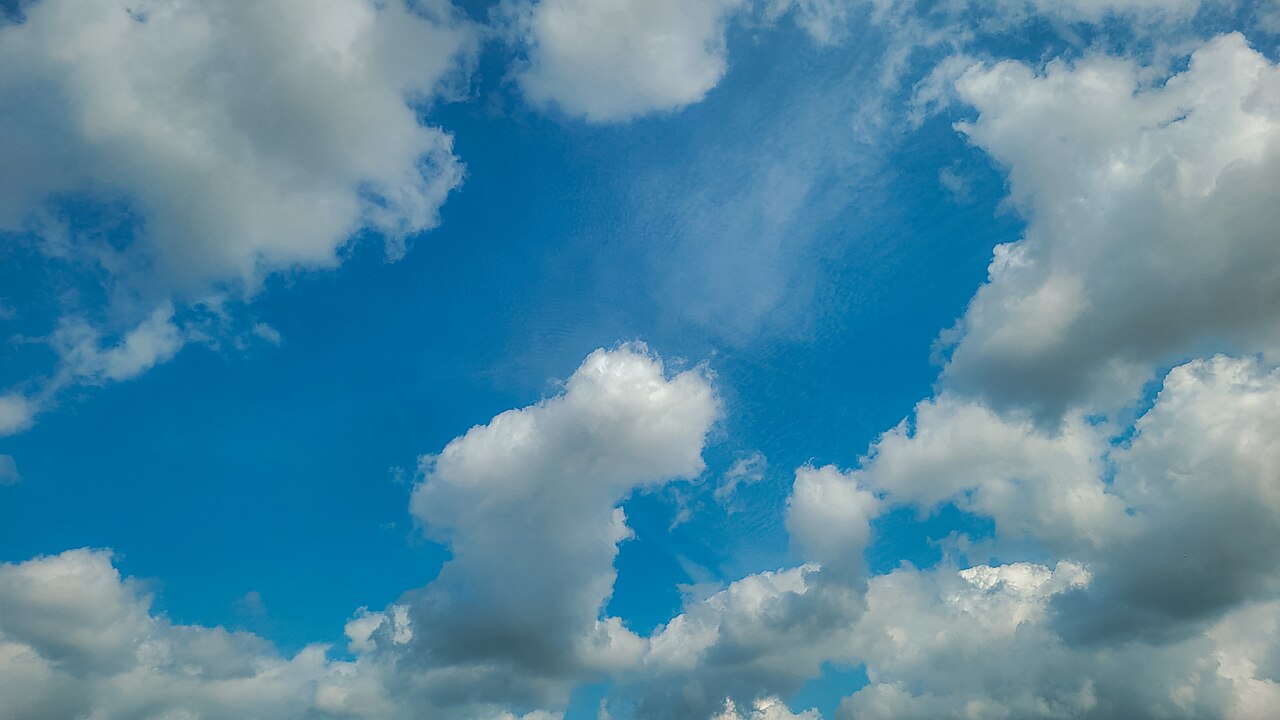
The sky appears blue because sunlight passes through Earth's atmosphere and interacts with tiny molecules of nitrogen and oxygen. Sunlight looks white but contains the full range of visible colors. These colors have different wavelengths: blue and violet are relatively short, while red and orange are longer. Molecules much smaller than those wavelengths scatter the shorter colors more effectively in many directions. As a result, when you look away from the Sun on a clear day, your eyes receive a great deal of scattered blue light from across the sky. This process is called Rayleigh scattering. The air is not actually painted blue, and the color does not come from the ocean reflecting upward. NOAA and the UK Met Office describe the same physical effect.
What is Rayleigh scattering and why does blue dominate?
Rayleigh scattering describes what happens when light encounters particles or molecules much smaller than the wavelength of visible light. In a simplified model, the intensity of this scattering increases strongly as wavelength gets shorter, approximately in proportion to one divided by wavelength to the fourth power. That is why the blue portion of sunlight is scattered several times more readily than the red portion in clean air. Scattered light reaches an observer from directions other than the direct line between the Sun and the ground. This also explains why an apparently transparent atmosphere can look richly colored when you view it across a long distance. Rayleigh scattering is not the same as the larger-particle scattering responsible for much of a cloud's white appearance.
If violet scatters even more, why isn't the sky purple?
Violet light has a shorter wavelength than blue, so Rayleigh scattering alone might suggest a violet-looking sky. Human vision and the distribution of sunlight also matter. Our eyes are less sensitive to violet than to nearby blue wavelengths, and the sunlight available at different visible wavelengths is not equally strong. Some violet wavelengths are also absorbed higher in the atmosphere. The combined light detected by the three kinds of cone cells in human eyes is therefore perceived mainly as blue, rather than as a saturated purple. According to NOAA, the balance between scattered blue and violet light and our visual sensitivity helps account for the everyday color. It is misleading to explain the blue solely by saying the atmosphere contains blue gas or that all violet light disappears.
Why are sunsets red and the sky paler near the horizon?
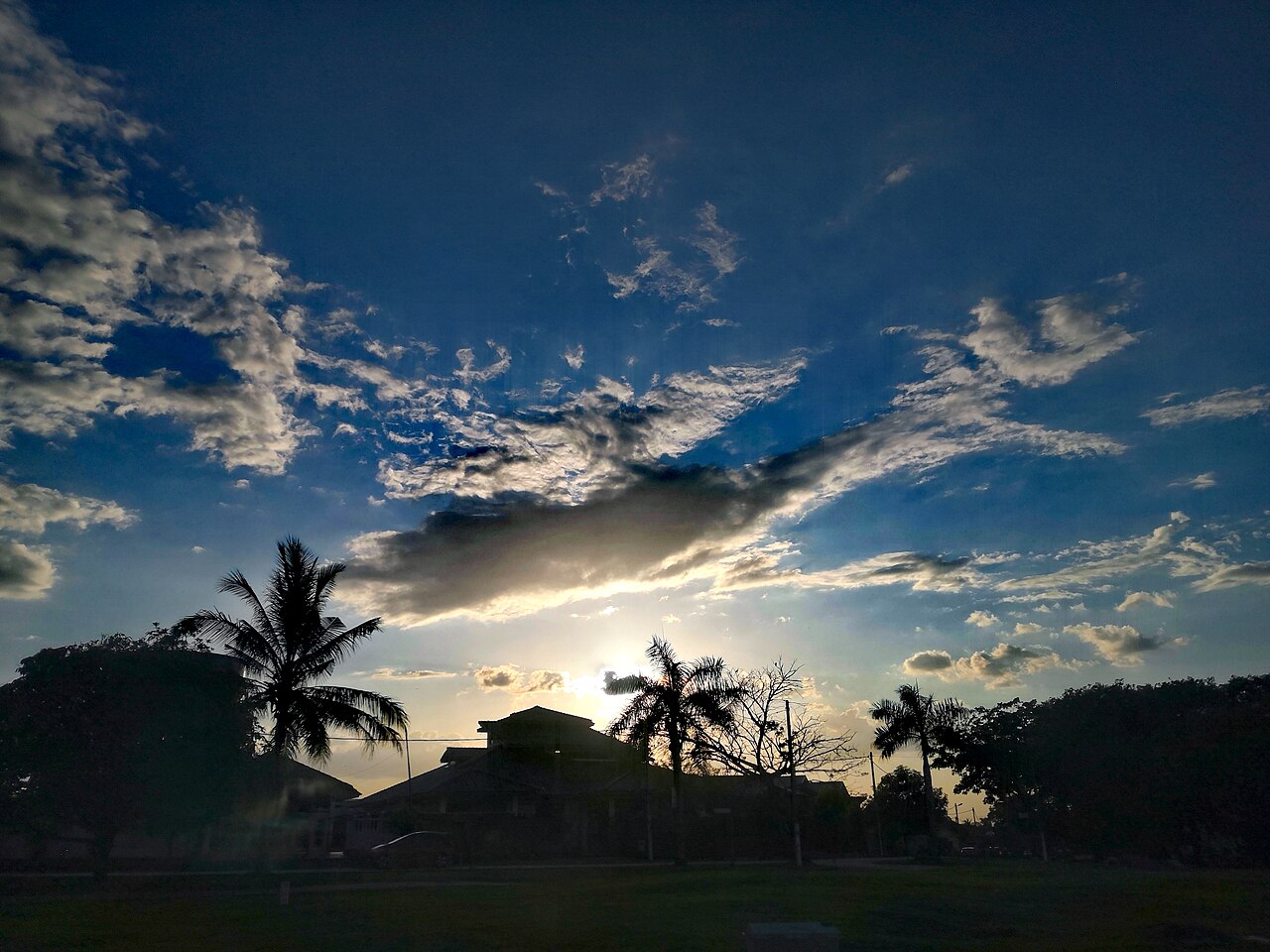
At noon, sunlight approaches an observer along a comparatively short atmospheric path. Near sunrise or sunset, the Sun is low and its light passes through a much longer stretch of air before it reaches you. More of the short-wavelength blue and violet light is scattered out of the direct beam, leaving proportionally more orange and red light from the low Sun. Dust, smoke, sea salt and other airborne particles can change the brightness and intensity of those colors. Away from the Sun, the horizon often looks pale blue or whitish because light travels through a longer air path and undergoes additional scattering. Not every brilliant red sunset is evidence of pollution, and a pale horizon does not by itself prove poor air quality. The colors depend on both geometry and atmospheric conditions.
Why are clouds white or gray if the clear sky is blue?
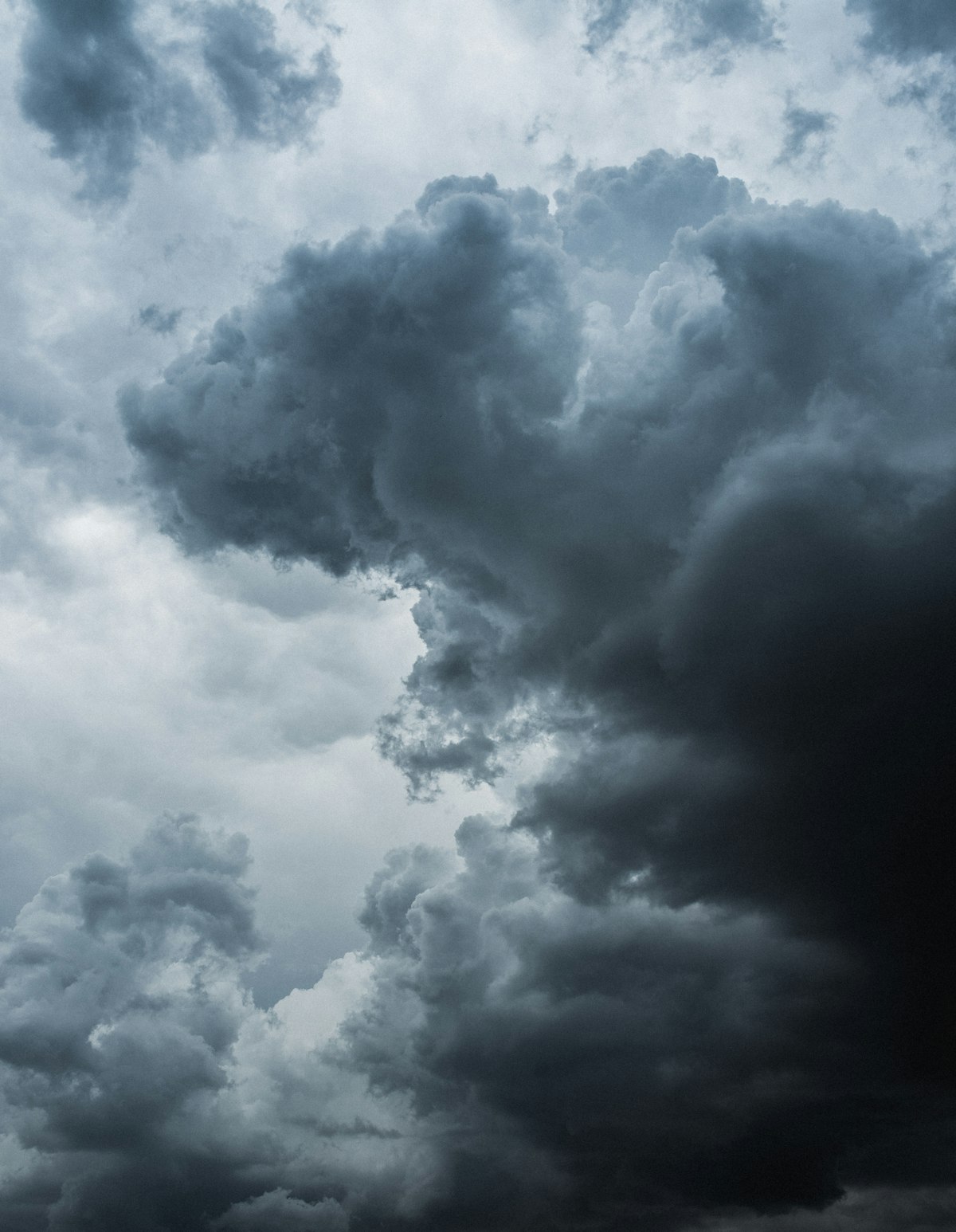
A clear sky is dominated by scattering from molecules that are tiny compared with visible-light wavelengths. Clouds contain much larger droplets of water or small ice crystals, which scatter visible colors more evenly. Their mixed light reaches our eyes as white, especially when the cloud is sunlit and relatively thin. A thick cloud may appear gray because its lower portions receive less sunlight and some light is blocked or scattered away before reaching the observer. The surrounding sky, shadow and viewing angle affect how gray it looks. This difference is why a white cumulus cloud can sit against a deep blue background without either being an illusion. To identify cloud layers and types, see /guides/cloud-types-field-guide/; for another atmospheric question, read /guides/why-lightning-zigzags/.
Is the sky blue in space, on other planets, and during every season?
Above nearly all of Earth's atmosphere, space looks black in directions away from bright objects because there are too few nearby molecules to scatter sunlight into your line of sight. A planet's daytime sky depends on the composition and density of its atmosphere and on suspended dust, not simply on how close it is to the Sun. Mars, for example, has a dusty atmosphere with different scattering behavior; do not assume every world's sky matches Earth's. On Earth the basic blue-sky physics operates throughout the year, but haze, cloud cover, solar angle and air conditions change what you see. You can observe the difference safely by comparing a clear patch overhead with the horizon and with a sunlit cloud—never stare directly at the Sun. Explore /guides/why-earth-has-seasons/ for why the Sun's apparent path changes with the seasons.
A general educational overview, not a substitute for professional guidance. Check current local rules and trusted primary sources before making consequential decisions.
Share this article