Wings that work as underwater flippers
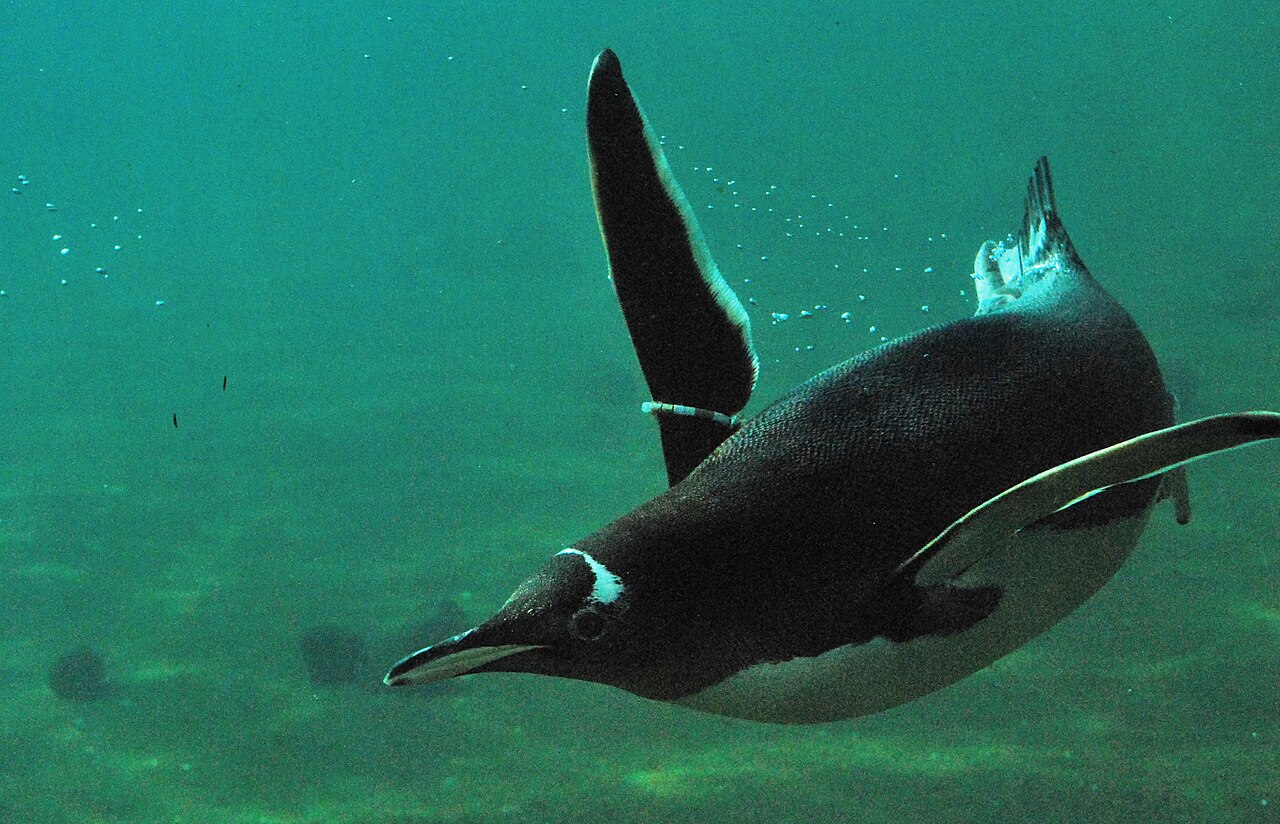
Penguins are birds, but their short, stiff wings are specialised for moving through water. Powerful muscles drive the flippers while the streamlined body reduces resistance. Underwater flight is a useful comparison for imagining the wing action, not a claim that a penguin can take off into the air. An underwater viewing window makes it especially easy to follow how strokes propel the bird forward.
Why flapping harder is not enough
Flight through air depends on wing area, body mass and the lift produced. Penguins combine short wings with comparatively heavy bodies, a combination unsuitable for aerial flight but useful for active swimming. This is evolutionary specialisation, not a conscious decision made by birds. Nor are all diving birds built alike: some other seabirds retain the ability to swim underwater and fly through the air.
Feet and tail help with steering
The wings provide the main underwater propulsion, while feet and tail help control direction. A penguin is not simply paddling its feet like a duck on a pond. Watch a sequence of acceleration, turning, gliding and another stroke. A single frozen photograph can misleadingly suggest that the wings are doing nothing. Changes in body position during a turn also help make sense of the movement.
Feathers rather than a fur coat
A smooth body seen from a distance can look furry, but its covering consists of feathers. Short overlapping feathers form a protective coat, while trapped air and a layer of fat help limit heat loss. Maintaining plumage has a practical purpose because its condition matters in water. A bird preening on shore is not necessarily bored or preparing to sleep; it is caring for protective equipment.
Diving still requires breathing air
Penguins breathe air and must return to the surface. Diving capabilities differ among species: a large emperor penguin’s record should not be attributed to a smaller bird of another species. The purpose of a dive also affects its duration. At an aquarium, several ordinary swimming and breathing cycles are more informative than waiting for a record. Brief leaps at the surface are not sustained aerial flight.
Snow is not a universal requirement
Penguins inhabit varied coastlines rather than a single permanently frozen habitat. Humboldt penguins, for example, occur along the coasts of Chile and Peru. A photograph of a penguin near sand or bare rock therefore does not by itself show an animal in the wrong place. Identify the species and location first. In the wild, leave routes to the water clear; at a zoo, watch quietly without tapping the glass.
A general educational overview, not a substitute for professional guidance. Check current local rules and trusted primary sources before making consequential decisions.
Share this article