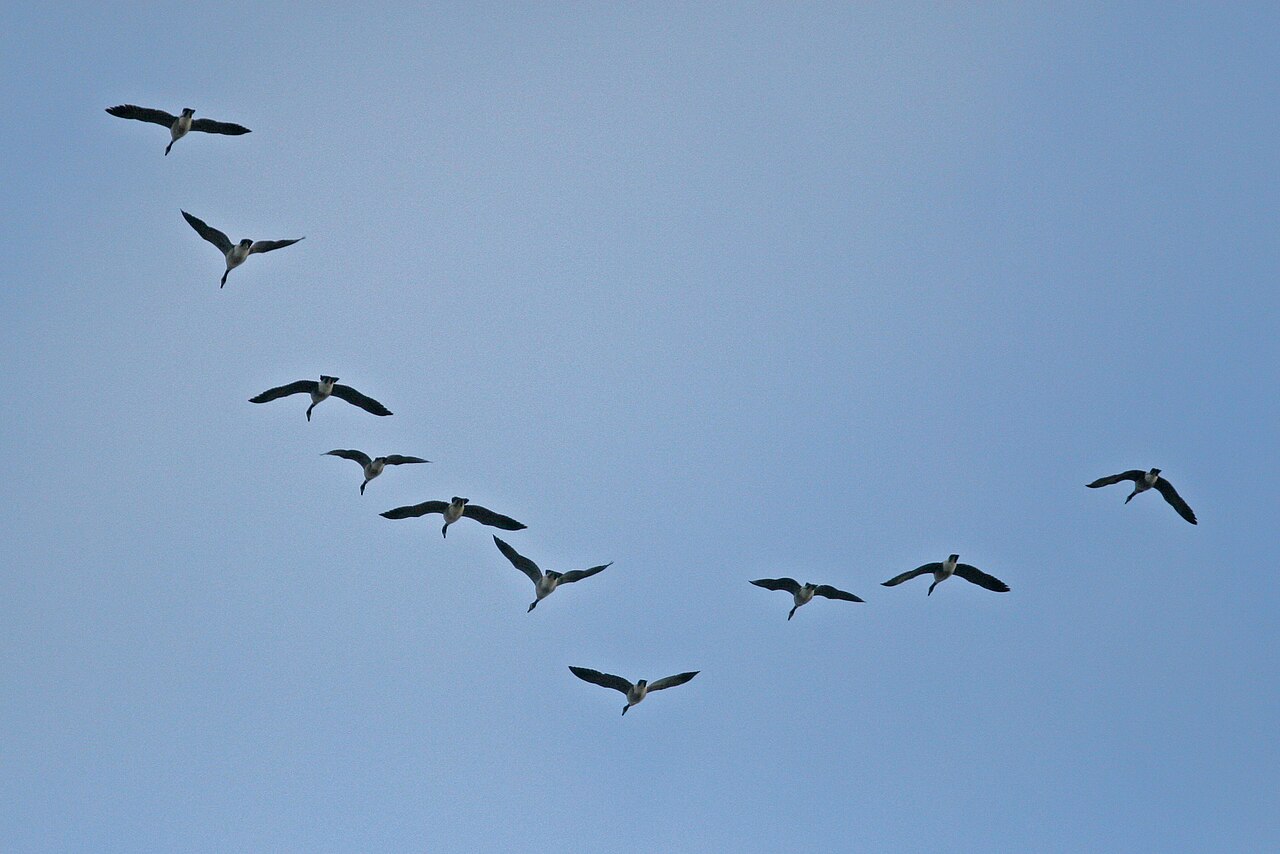
What you are seeing when geese form a V
Many relatively large flying birds, including geese, pelicans, cranes, ibises and some other species, sometimes travel in a staggered or V-shaped flock. They do not form a perfectly symmetrical letter on every flight, and not all migratory birds use this pattern. The individual positions shift with the wind, flight direction and the number of birds. A flock is not necessarily following the oldest or most dominant member. To understand why the pattern helps, we need to look at what each moving wing does to surrounding air.
The physics: a wing creates both upwash and downwash
A bird's wing produces lift by moving air and creating pressure differences. Near the wingtips, circulating vortices leave a complex wake with regions of air deflected upward, called upwash, and air pushed downward, called downwash. A following bird positioned behind and slightly to one side may benefit from the upward component, reducing some of its effort to stay aloft. Flying directly in the most unfavorable downward flow would be less helpful. Smithsonian's How Things Fly explains this aerodynamic advantage with reference to wingtip vortices and drag.
What the northern bald ibis experiments actually proved
In a 2014 study published in Nature, scientists tracked northern bald ibises with fine-scale data loggers as they flew in formation. The birds tended to occupy aerodynamically favorable relative positions and synchronized the paths of their wing tips with those of neighboring birds. That timing helps them exploit changing upwash during each wingbeat. This is direct evidence of a sophisticated behavior in the studied species, not proof that every bird flying in a group deliberately uses identical timing or saves an exact fixed percentage of energy.
Do birds take turns at the front?
The lead bird cannot enjoy the same upward airflow from another bird directly in front. In many formations, leadership changes as individuals move forward and backward within the flock. A separate study of ibises described birds sharing leading and following positions, suggesting cooperation and reciprocal benefits among partners. It would be simplistic to claim there is always a single heroic leader that flies until completely exhausted. The pattern is dynamic, and factors such as wind, group composition and available space influence which bird is in front.
How much energy does a V save?
It is tempting to quote one universal number, but estimated savings differ with species, formation spacing, wing shape and flight style. Audubon cites studies suggesting advantages around 10–14 percent for some trailing birds; other theoretical estimates assume nearly optimal geometry and can be much higher. Results from ibises, geese and pelicans are not automatically interchangeable. The useful conclusion is that properly positioned birds can gain an aerodynamic advantage and that the formation may help on demanding journeys. Claiming that every V-shaped flock uses exactly half the energy would be misleading.
Why this matters during migration
Long-distance travel demands fuel and coordination. A formation can help some birds use airflow more efficiently while retaining visual contact with neighboring members. Birds also communicate through calls, but the aerodynamic pattern itself is not a simple navigational arrow telling the group where north lies. Migration routes depend on species, experience, seasonal cues and environmental conditions. For other animal science on MURDILIMAX, read /guides/why-cats-purr-science/ and explore /topics/wildlife/. Watch wild flocks from a safe distance without disturbing resting or nesting birds.
A general educational overview, not a substitute for professional guidance. Check current local rules and trusted primary sources before making consequential decisions.
Share this article