Why sunrise does not switch the Moon off
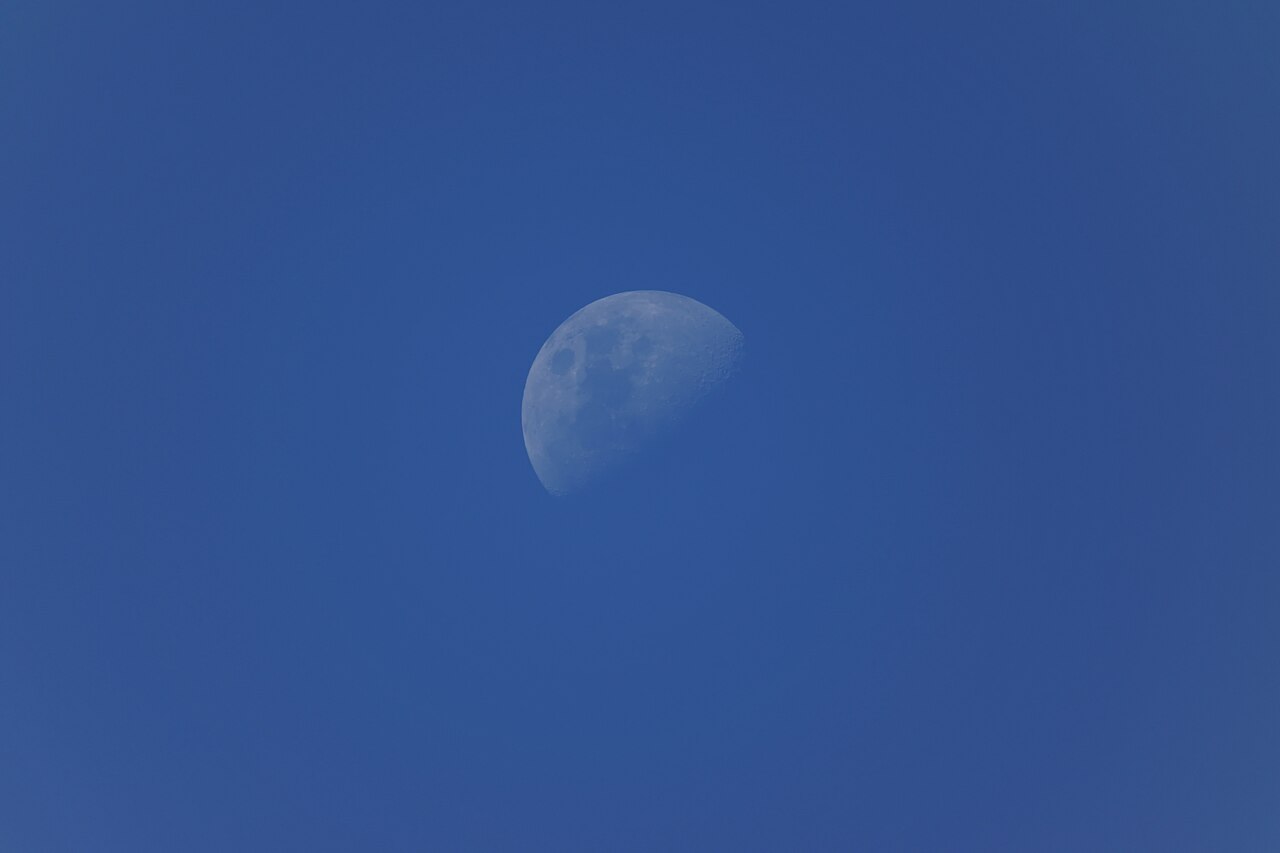
The Moon reflects sunlight during the day just as it does at night. To see it, it must be above your horizon, present an illuminated portion towards Earth and stand out against a sufficiently clear sky. A daytime Moon is not evidence of an unusual close approach. Our familiar symbol of night simply does not have to disappear when the Sun rises.
Choose a useful observing window
For a first attempt, try the afternoon on days around first quarter. Around last quarter, morning is a better starting point. These are broad guides, not a timetable: rise time, altitude and direction depend on your date and location. Check local moonrise and moonset predictions, then choose a place with an open view rather than buildings or trees blocking the sky.
Why a full Moon is less convenient
A full Moon lies roughly opposite the Sun in our sky, rising around sunset and setting around sunrise. That makes its bright round disc mainly a nighttime sight. At new Moon, the side facing us is largely unlit and the Moon appears close to the Sun’s direction. Brightness alone therefore does not determine daytime visibility; the geometry matters as well.
What your eyes can reveal
Start with the shape of the illuminated portion and the larger dark markings. The lunar seas, or maria, contain no liquid water: they are broad areas of ancient solidified lava. Lighter regions have a different composition and surface history. Do not expect unaided eyes to reproduce a heavily magnified photograph. Shadows near the day–night boundary help reveal relief, particularly with optics used under safe conditions.
Why you might not find it today
An empty patch of sky proves little. The Moon may be below the horizon, behind a building or hidden by cloud; weak contrast can also defeat a search. Try again after checking local rise times. Never sweep binoculars or a telescope near the Sun while hunting for a thin crescent: accidental solar viewing can damage your eyes. Begin with unaided viewing well away from the solar disc.
Keep a simple observing notebook
Record the date, time, location, cloud cover and visible shape on each attempt. Sketch the Moon and mark its position relative to a fixed landmark such as a roof. Include unsuccessful attempts so that weather does not get confused with changes in visibility. Avoid comparing only photographs taken at different magnifications. After a week, review how the shape and position changed, then continue towards a full lunar cycle.
A general educational overview, not a substitute for professional guidance. Check current local rules and trusted primary sources before making consequential decisions.
Share this article