The short answer: stripes can discourage biting flies
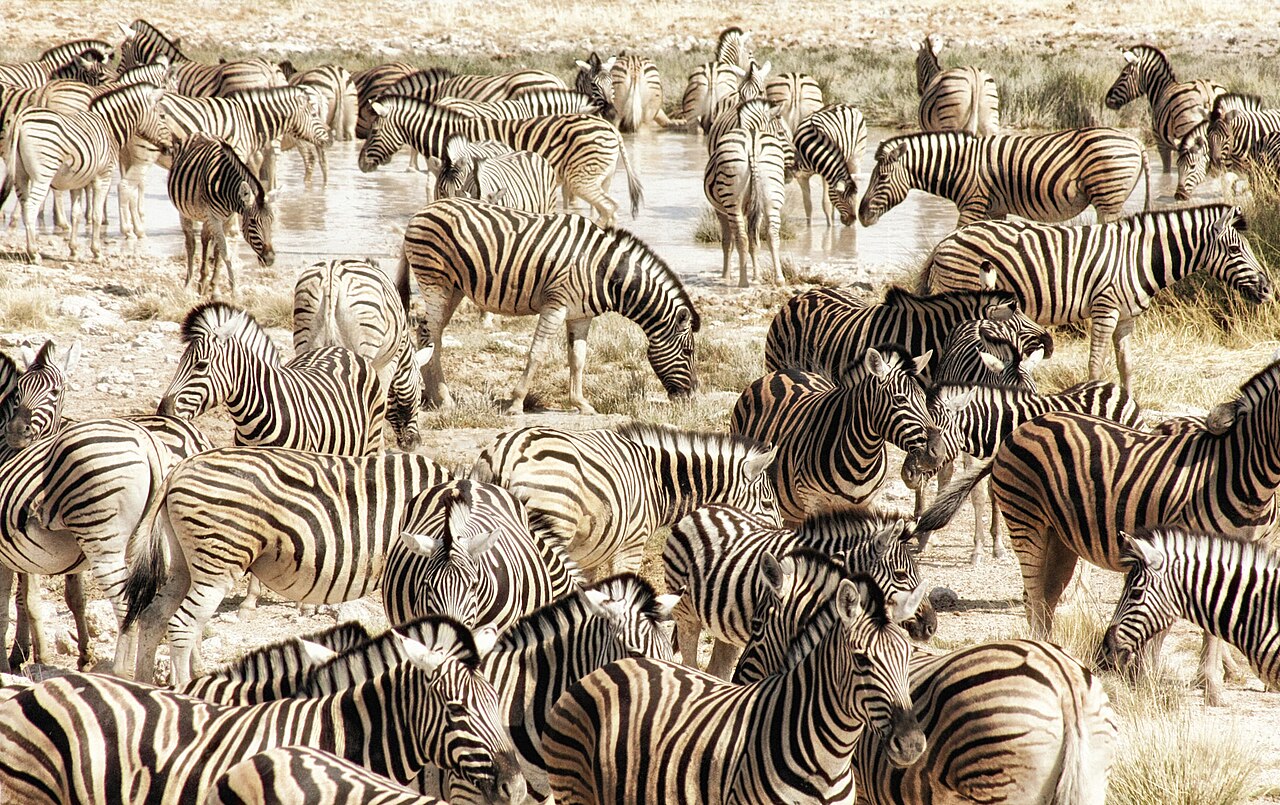
Zebra stripes look striking to people, but their evolution has been debated for more than a century. Among the main explanations, scientific studies currently offer the strongest direct evidence for reducing attacks by certain biting flies. These insects can bite large mammals, take blood and potentially transmit diseases. Experiments in which researchers watched horseflies approach zebras and horses found that flies made fewer controlled landings on striped coats. However, this does not establish that every species of fly is equally affected or that avoiding flies explains every detail of zebra markings. A 2025 review in Biological Reviews concluded that the fly-deterrence hypothesis has the best empirical support, while still leaving important questions about stripe placement and variation among zebra species. Stripes are therefore a tested protective feature, not simply nature's decoration, but their full evolutionary history remains open to study.
What happens when a horsefly approaches a striped coat?
The difference seems to become important near the animal rather than far away. In a 2019 study led by researchers from Bristol and UC Davis, horseflies were observed approaching zebras and domestic horses. The insects circled the animals at broadly similar rates, yet far fewer landed successfully on the zebras. Slow-motion video helped reveal that the flies often failed to decelerate properly and made contact rather than a controlled landing. Researchers also put striped coats on domestic horses: fewer flies landed on the covered parts compared with more uniform-looking surfaces. The results support the idea that the visual pattern interferes with the insects' final approach. They do not show that a zebra is invisible to flies, or that the stripes prevent every bite. The animals still use tail movements, skin twitching and other behaviour to defend themselves against nuisance insects.
Why do black-and-white patterns change insect landings?
Scientists continue to test precisely what a fly sees when it approaches stripes. Strong contrast, the scale of the pattern and the insect's visual processing are all possible ingredients. In 2023, a Journal of Experimental Biology study tested differently patterned coats on horses and found that horseflies avoided high-contrast stripes more than lightly contrasting ones. The researchers did not find support for every proposed mechanism, including an explanation centred on polarized reflected light, and they cautioned against assuming a single optical trick has already been proved. A 2022 field experiment in Kenya also found that biting flies preferred relatively uniform impala skins over striped zebra skins in an enclosed test. Together, these studies strongly support fewer fly landings, especially at close range. Exactly how that produces the evolutionary pattern on each zebra species remains a separate scientific question.
Are zebra stripes camouflage or a way to confuse lions?
A popular explanation says that the stripes blend into grass or make it hard for a lion to select one zebra in a running herd. Those ideas are plausible enough to investigate, but the experimental and ecological evidence so far is less convincing than the evidence involving flies. Zebras are often conspicuous in daylight, and predator vision does not necessarily perceive fine stripes from the same distances as a human observer. The 2025 Biological Reviews paper examined several anti-predator hypotheses and found that none neatly accounts for the placement, width and diversity of the markings across all three living zebra species. This does not mean a moving herd can never confuse an individual predator, or that appearance plays no role in social interactions. It means a familiar visual story should not be promoted as the established reason zebras evolved stripes when better tested explanations exist.
Do the black and white stripes help zebras stay cool?
Another hypothesis links different heating of black and white hair to air movement across the coat, potentially assisting temperature regulation in hot landscapes. Zebra habitats can indeed become very warm, and scientists have examined how coat patterns interact with sunlight, wind and skin temperature. But simply measuring a temperature difference between dark and pale stripes does not prove that the animal is cooled enough to explain the evolution of its markings. The 2025 review found that thermoregulation theories still struggle to account for the full variety of stripe widths and their distribution across the body. Cooling might interact with other features of the animal, yet its contribution has not been established as the primary reason for the pattern. An accurate answer therefore separates possible physiological benefits from demonstrated reductions in insect landings.
Are the stripes unique to each zebra, and is the mystery solved?
A zebra's arrangement of stripes varies across individuals and also between species and populations. Plains, mountain and Grévy's zebras do not all carry identical patterns. That variation makes it tempting to describe stripes as individual identity cards, and recognition could be one of several social functions, but the mere fact that coats differ does not prove why evolution produced them. The 2025 scientific review points out unresolved questions: why other grazing mammals are less strongly striped, why certain body regions differ, and whether interspecies communication has played a role. Researchers can confidently say that high-contrast stripes often reduce close-range landings by some biting flies; they cannot yet reduce the entire mystery to one universal cause. You can read about another curious animal response at /guides/why-dogs-tilt-their-heads/ or explore /topics/wildlife/ for more wildlife questions.
- University of Bristol — Research reveals why the zebra got its stripes (2019) ↗
- PLOS ONE (2019) — Benefits of zebra stripes: behaviour of biting flies around zebras and horses ↗
- Scientific Reports (2022) — Zebras of all stripes repel biting flies at close range ↗
- Journal of Experimental Biology (2023) — Why don't horseflies land on zebras? ↗
- Biological Reviews (2025) — Zebra stripes: the questions raised by the answers ↗
A general educational overview, not a substitute for professional guidance. Check current local rules and trusted primary sources before making consequential decisions.
Share this article