What is actually glowing
Gases in Earth’s upper atmosphere emit the light. Fast electrons collide with atoms and molecules and transfer energy to them. As the gas particles return to less excited states, they release light. This is not sunlight reflected from snow or a glowing cloud in deep space: it happens in our atmosphere, although its energy source is connected to the Sun.
Why green and red appear together
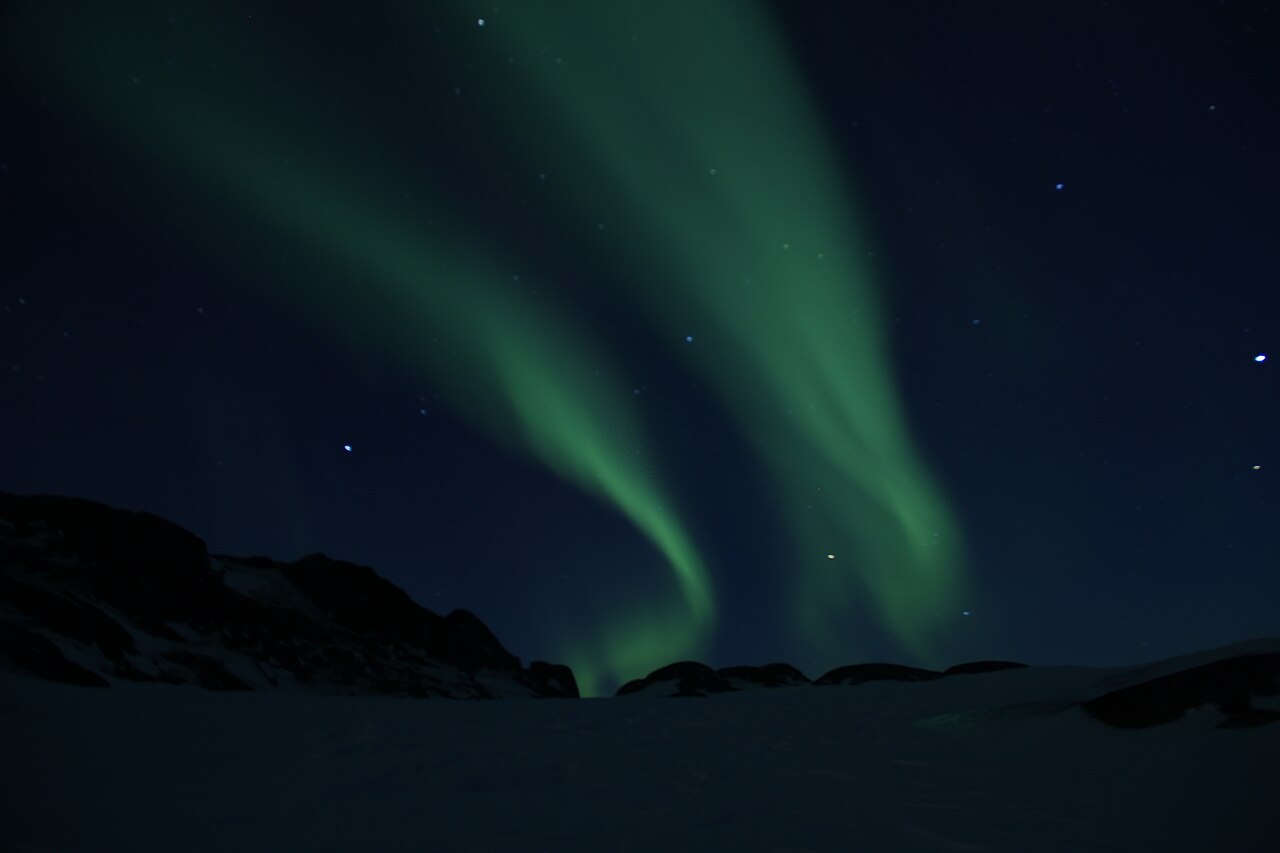
Oxygen produces characteristic green and red emissions, while nitrogen contributes blue, pink and purple. Colour depends on altitude and collision conditions as well as the gas involved. A display can therefore contain several layers. A photograph cannot precisely measure an aurora’s height: the camera’s colour response and subsequent processing also affect what you see.
Why the polar regions get more displays
Charged-particle motion is linked to Earth’s magnetic field. Regions where auroras commonly occur form ovals around the magnetic poles. Strong geomagnetic activity can expand the area of visibility towards lower latitudes. A corresponding display occurs in the Southern Hemisphere: the southern lights. The familiar northern name does not mean the phenomenon exists in only one hemisphere.
Can they be seen in the Baltic region
Sometimes, during suitable geomagnetic activity. A high activity index does not guarantee a visible display in a particular town. Darkness, clear enough skies and an open view also matter; clouds can hide even a strong aurora. Before travelling, compare a current NOAA forecast with local cloud cover. An impressive old photograph is not evidence of a display tonight.
Why a phone can reveal more colour
Human colour vision becomes less effective in dim light. A camera using a long exposure collects light over time and may reveal colours that are faint to the eye. Keep the phone still and try its night mode, but do not assume every green glow is an aurora. Reflections, illuminated clouds and image processing can be misleading.
Prepare for an observation
Choose a permitted, safe location away from bright lamps and check the route and weather beforehand. Let your eyes adjust to the dark and watch for changing shapes as well as colour. Record the time and viewing direction: that makes a photograph more useful for comparison with forecasts. Auroras are dynamic, and even careful preparation cannot guarantee a display.
A general educational overview, not a substitute for professional guidance. Check current local rules and trusted primary sources before making consequential decisions.
Share this article