A bubble tends to minimise its surface
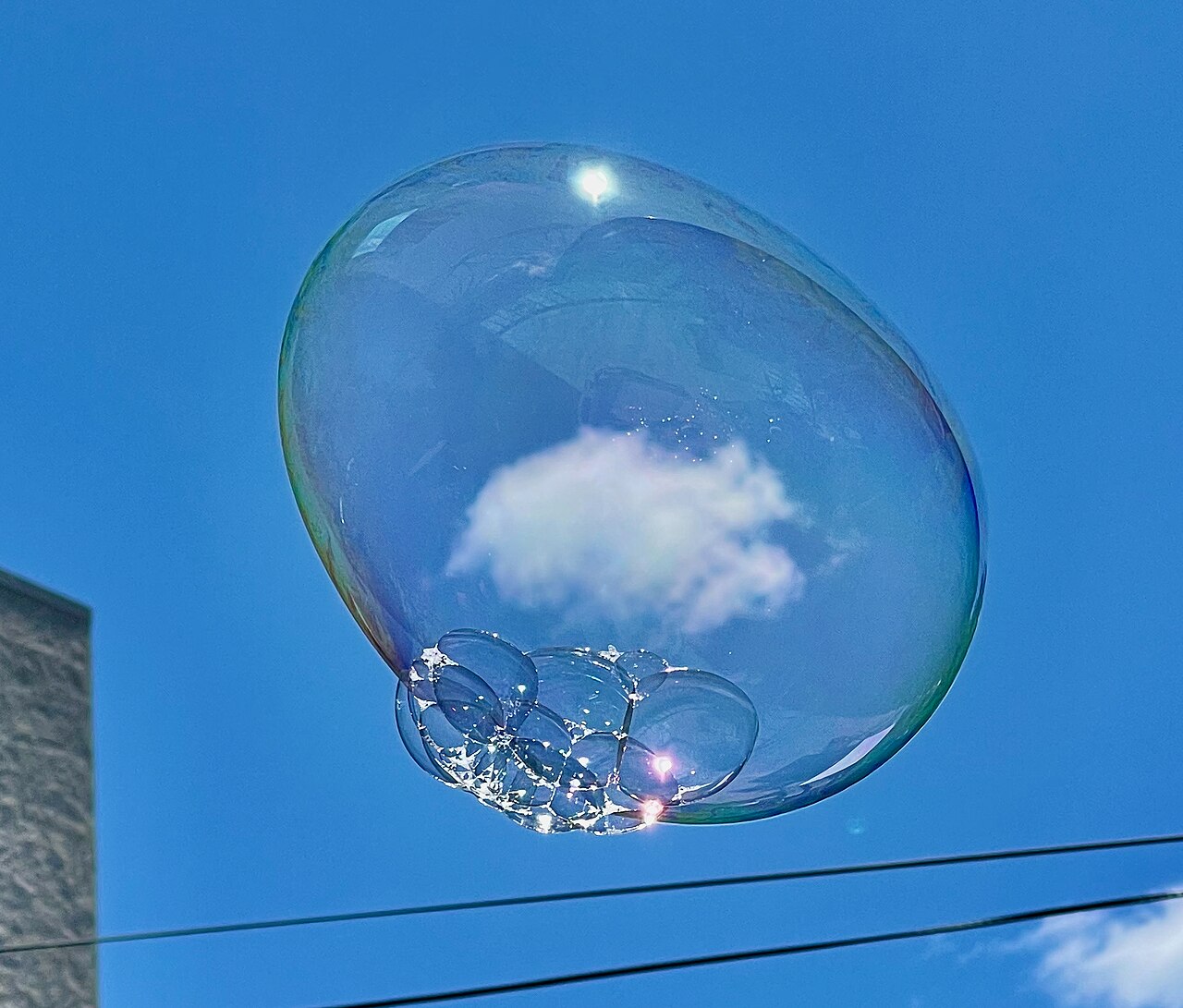
A small free-floating bubble is usually close to spherical. For a given volume of air, a sphere has the smallest surface area, and the film’s surface tension favours that shape. This does not mean every bubble is always perfectly round: airflow, attachment to a frame and neighbouring bubbles can distort it. A large elongated bubble often changes shape after release.
Why add soap to the water
The wall is a thin water layer with surface-active molecules at its boundaries with air. Soap lowers water’s surface tension and helps create a more stable film. Saying that soap makes surface tension stronger is therefore incorrect. A long-lived free bubble is much harder to produce from pure water. Adding more detergent is not automatically better either: formulation and conditions also matter.
Where the shimmering colours come from
Some light reflects from the film’s outside surface and some from its inside surface. These waves combine, strengthening the reflection of certain wavelengths and weakening others. This is thin-film interference. The colour depends on film thickness and viewing angle. A transparent solution can consequently produce bright colours without added dye or a real rainbow reflected from the sky.
Why the colour bands keep moving
Liquid redistributes, drains and evaporates within the wall, so film thickness changes across the bubble and over time. Its colours change with it. On a bubble held by a frame, bands and a thinner upper region may become noticeable. A casual photograph without controlled lighting cannot reliably measure the entire film’s thickness: an attractive colour is not a ready-made measurement scale.
What happens when bubbles meet
Touching bubbles can form a shared wall and no longer look like separate spheres. At equilibrium, equal-sized bubbles have a flat shared wall, while different-sized bubbles have a curved one. This creates the familiar structure of foam. It does not break the minimum-surface principle: the films now partition several volumes of air and must accommodate neighbours rather than just one isolated bubble.
Compare two different frames
Use ready-made bubble solution and two safe wands with differently shaped openings. Predict the results first, then compare the bubbles after they leave the frames. Work in still air and diffuse light without looking at the Sun. Never drink solution or suck it through a straw; supervise children. Wipe up spills to prevent slipping and keep the solution out of natural ponds and streams.
A general educational overview, not a substitute for professional guidance. Check current local rules and trusted primary sources before making consequential decisions.
Share this article