The white line is mostly ice
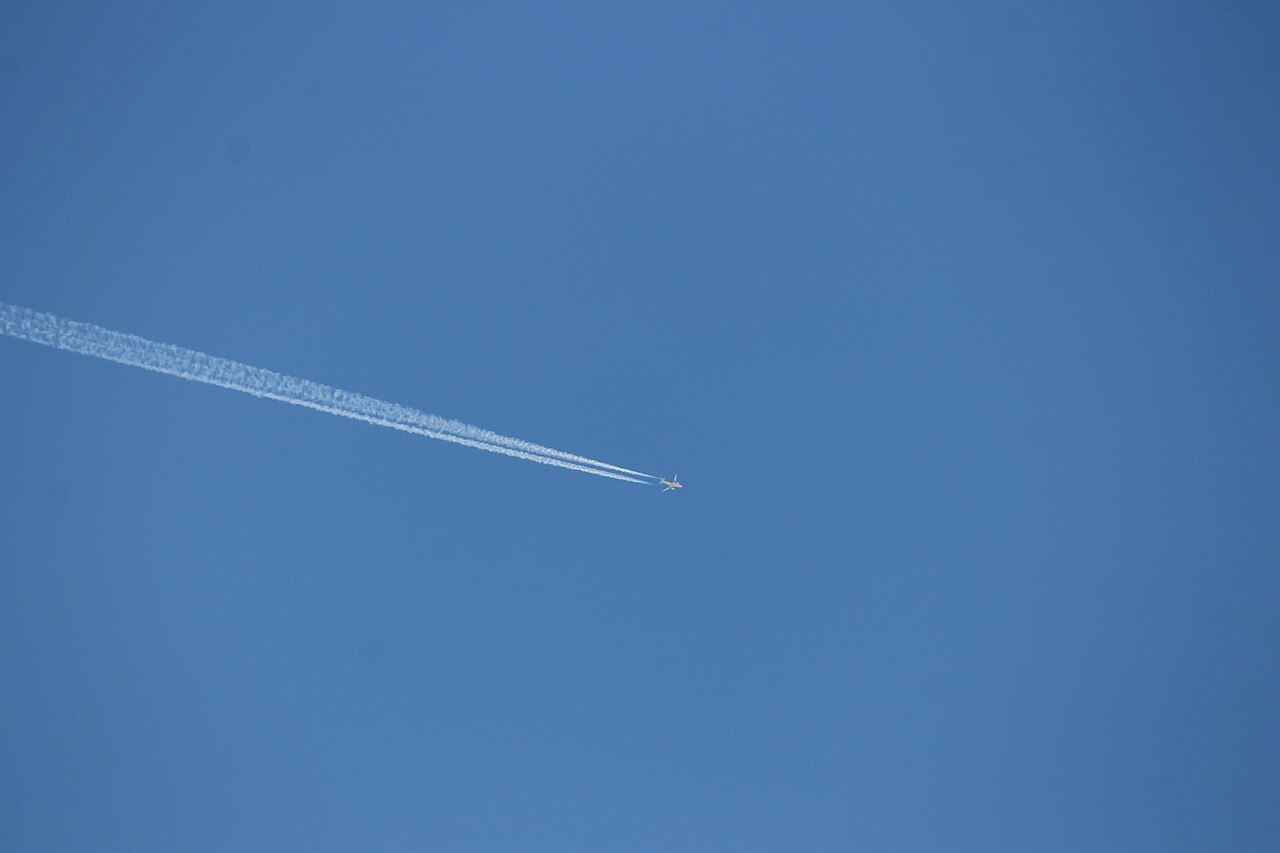
At cruising altitude, hot, moist engine exhaust mixes with very cold surrounding air. Under suitable conditions, tiny droplets form and freeze into ice crystals. These scatter light and become visible as a white line. The term contrail is short for condensation trail: it describes a cloud produced in connection with the aircraft’s passage.
Why some aircraft leave no visible trail
Temperature and humidity at flight altitude matter, not just the weather outside your house. Two aircraft that look close together from the ground can occupy different atmospheric layers. Conditions may favour a contrail in one layer but not another. The absence of a white line does not, by itself, indicate an unusual aircraft design.
Why some trails remain for a long time
In dry air, ice crystals quickly change directly into water vapour and the line vanishes. In moist air, a trail can persist, grow and spread into thin cloud. Winds move and reshape it. Long persistence is compatible with an ice-crystal cloud: the surrounding atmosphere determines how long that cloud can survive.
Where gaps and crossing lines come from
An aircraft may cross patches of air with different conditions, producing separated visible sections. Crossings reflect flight paths, the time aircraft passed and subsequent movement by wind. Two lines in a photograph need not have formed simultaneously. A single image without timing, viewing direction or weather context tells you little about a particular flight.
Does an ice cloud mean no environmental impact
No. Explaining the visible line does not mean aviation has no emissions or climate effects. Fuel combustion releases carbon dioxide and other substances, while persistent contrails can change cloud cover and Earth’s radiation balance. Researchers examine these effects separately; the appearance of one line does not let you calculate its contribution.
A simple observation without instruments
Choose one trail and photograph it repeatedly from the same position, recording the time. Note whether it disappears, spreads or moves with the wind. You can see that the line behaves like a cloud rather than remaining fixed to the flight path. Do not look directly at the Sun; choose a safe viewing direction. Use a weather forecast, not a single contrail, to plan around upcoming conditions.
A general educational overview, not a substitute for professional guidance. Check current local rules and trusted primary sources before making consequential decisions.
Share this article